

For the past two years, organizations have been focused on a growing concern…
Are Our Employees uploading sensitive information into public AI tools?
Security leaders have rushed to create policies around employees using ChatGPT, Claude, Gemini, and dozens of other generative AI platforms. And rightfully so. Many questions quickly emerged –>
- Are employees uploading customer PII?
- Are developers pasting proprietary code?
- Are analysts sharing internal documentation?
- Are employees unknowingly violating compliance requirements?
This became known as Shadow AI… the unauthorized use of public AI platforms outside organizational oversight. But while companies were focused on stopping employees from using external AI tools… A far bigger risk has secretly emerged.
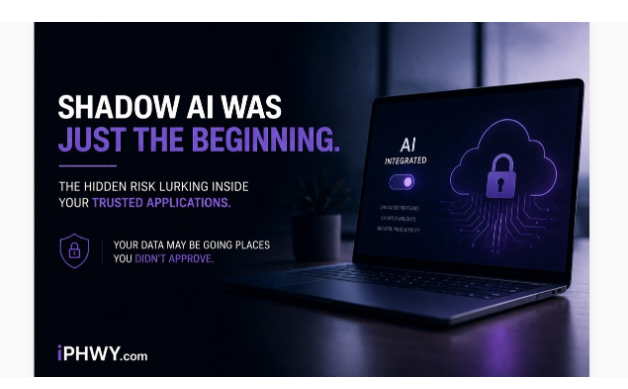
Heads-Up! Your approved vendors may already be using AI with your data
The question many organizations need to be asking: What happens when the software platforms you already trust begin embedding AI into their products?
Think about how many platforms have introduced AI capabilities almost overnight –>
- Microsoft 365 Copilot
- Salesforce Einstein
- Zoom AI Companion
- Slack AI
- GitHub Copilot
- Notion AI
- countless cybersecurity platforms now adding AI copilots
Many of these platforms were originally approved before AI functionality existed. Then one day users log in and see…
“Try our new AI assistant!”
“Enable smart summaries!”
“Use AI recommendations!”
“Ask our AI chatbot anything!”
What many organizations fail to realize is that their original vendor risk assessment may now be outdated.
Enter… The invisible data path problem
When users interact with these features, where exactly does the data go? Does it stay within the vendor’s environment? Does it get processed by OpenAI, Anthropic, Google, or Amazon Web Services? Is the data being retained, used for training, or shared with third-party processors? Is it human reviewed?
Many organizations simply do not know. And that should concern every executive team.
Being Told “Our AI is proprietary” may not mean what you think
Many software vendors market their platforms as having “Proprietary AI”. That sounds reassuring, until you discover they may simply be consuming third-party LMM APIs, using external inference providers, leveraging external data processors, and introducing additional subprocessors you never approved.
And just like that, your vendor risk chain becomes:
Your company –> SaaS vendor –> AI provider –> infrastructure provider
That creates a visibility challenge many procurement and security teams are not prepared for.
Many Security teams are reviewing the wrong threat model
Most companies remain focused on employee misuse, while ignoring vendor AI exposure. This is becoming a far larger challenge because employees may be using AI features embedded inside applications leadership already approved.
That means:
- CRM systems
- collaboration platforms
- ticketing platforms
- security tools
- monitoring tools
- documentation systems
- development platforms
And in many cases, users may not even realize they are interacting with AI systems.
The compliance nightmare
Now consider organizations operating under:
- HIPAA
- PCI DSS
- GDPR
- CCPA
- financial regulations
- contractual customer obligations
What happens if customer data is routed through AI processors your legal or compliance teams never reviewed?
What happens if prompts are retained, or customer conversations help train future models?
These regulatory implications are still evolving. But the legal exposure may arrive much faster than organizations expect.
What you should be asking vendors right now
If your vendors have introduced AI functionality, it’s time to ask:
- Is customer data used to train models?
- Is prompt data retained?
- Can AI functionality be disabled?
- What third-party AI providers are involved?
- Are prompts human reviewed?
- Where is data stored?
- Are outputs logged?
- Have your terms of service changed?
If your vendors cannot clearly answer these questions…That should be a red flag.
Shadow AI version 2.0 is already here
The original fear was employees secretly using public AI tools. This next phase is far more dangerous, as our trusted vendors are quietly embedding AI into platforms where your sensitive data already lives. This is harder to detect and govern. And far harder to unwind once sensitive information has already moved.
It’s time to update vendor questionnaires, review contracts, require AI disclosure clauses, evaluate subprocessor risks, limit sensitive data exposure, and implement AI governance frameworks. This is no longer just an IT problem, it’s a boardroom conversation.
Shadow AI was never the end of the story, just the warning sign. The bigger question is now, “Do you know which of your trusted vendors are quietly using AI with your data?”
Because if you don’t already know… you may already have far more exposure than you realize.