

Merger announcements are often met with excitement…and rightfully so.
They can accelerate growth, expand market reach, strengthen service portfolios, and create new opportunities for customers, employees, and stakeholders alike. Leadership teams spend months evaluating financials, legal structures, valuations, market fit, and long-term business strategy before these deals are finalized.
Those conversations are critical.
But once the announcement is made and the excitement settles, organizations enter one of the most complex phases of any merger…
The Integration.
And this is where many organizations underestimate risk. This isn’t commentary on any one company, it’s a lesson that applies broadly across nearly every merger I’ve observed or participated in throughout my career. Having worked through mergers from both operational and leadership roles, one lesson continues to stand out…
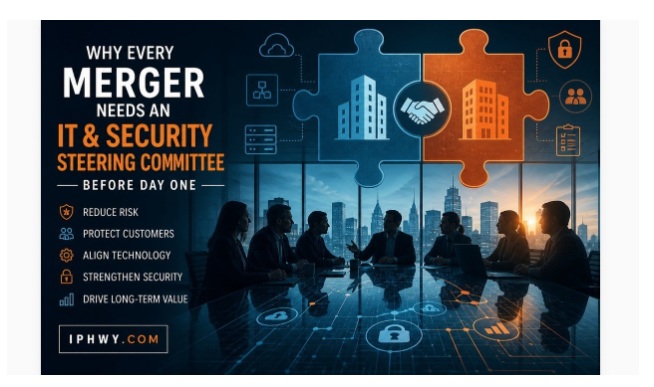
Organizations that establish a dedicated IT & Security Steering Committee early are often far better positioned to avoid disruption, reduce risk, and accelerate integration success.
Without one, integration efforts can quickly become reactive, fragmented, and unnecessarily expensive.
Why I Believe IT and Security Often Get Pulled in Too Late
In many mergers, technology teams are brought in after major business decisions have already been made. By that point, organizations may already be dealing with –>
- Duplicate platforms and tools
- Overlapping vendors and licensing contracts
- Inconsistent cybersecurity controls
- Legacy infrastructure nearing end-of-life
- Incomplete documentation
- Cloud sprawl
- Identity and access inconsistencies
- Unknown compliance obligations
- Undocumented operational dependencies
What looks simple on paper can quickly become operationally complex. Two companies may both appear technologically mature, but behind the scenes, they may be operating with completely different architectures, security models, workflows, and support structures. That complexity needs leadership and coordination.
What an IT & Security Steering Committee Should Actually Do
This group shouldn’t exist for meetings that generate more meetings. Its purpose should be to drive structured decision-making across the integration process. The committee should typically include:
- CIO / CTO leadership
- CISO / Security leadership
- Infrastructure leadership
- Application owners
- Compliance/legal teams
- HR leadership
- Finance stakeholders
- PMO/integration leaders
- Operational department leaders
Their job is to identify risk early and create a roadmap for integration.
1. Assess Infrastructure Overlap
In my experience, this often becomes one of the largest cost and operational challenges.
Some questions to answer…
- Are both organizations maintaining separate data centers?
- What cloud providers are being used?
- Are disaster recovery capabilities aligned?
- Are there overlapping telecom providers?
- Are there redundant monitoring tools?
- Are hardware refreshes being delayed?
Mergers often expose infrastructure debt that existed long before the acquisition.
2. Evaluate Security Risk Exposure
This area is frequently underestimated.
Questions leadership should ask…
- Are both organizations using different EDR platforms?
- Are security policies aligned?
- Are privileged accounts properly controlled?
- Are there inherited vulnerabilities?
- Are third-party vendors introducing new risk?
- Are both organizations operating under the same compliance requirements?
Security gaps become much harder to fix after environments are deeply integrated.
3. Rationalize Applications and Platforms
This becomes a major cost issue if ignored.
Organizations often discover duplicate…
- CRM systems
- Ticketing platforms
- Monitoring platforms
- Collaboration tools
- SaaS subscriptions
- Reporting systems
Keeping duplicate systems too long increases cost. Eliminating systems too quickly creates operational disruption. I feel that this requires deliberate planning.
4. Protect Institutional Knowledge
This is one of the most overlooked merger risks. Critical knowledge often lives with specific employees…
- undocumented scripts
- vendor relationships
- infrastructure quirks
- application workflows
- emergency procedures
- legacy integrations
If key personnel leave during integration, organizations can lose years of operational knowledge overnight.
5. You MUST Maintain The Customer Experience
Customers should never feel internal merger turbulence. The steering committee should ensure continuity for…
- support operations
- service delivery
- billing processes
- customer communication
- uptime expectations
- contract obligations
The fastest way to damage a merger’s value is to disrupt customer trust.
Integration Is a Leadership Discipline
Mergers don’t create technical debt. They often expose the technical debt both organizations were already carrying. They also reveal process gaps, ownership confusion, and operational blind spots that may have gone unnoticed for years. That’s why integration requires structure, not panic. No rush to consolidation. And certainly not siloed decision-making.
Remember… the merger announcement may be the headline, but integration determines whether the deal actually delivers long-term value. Organizations that treat IT and security integration as a strategic business function, not simply an operational afterthought, tend to move faster, reduce unnecessary risk, and create far smoother transitions for both employees and customers.
A strong steering committee won’t eliminate every challenge. But it can prevent small issues from becoming major operational problems later. And in my experience, that preparation makes all the difference.