
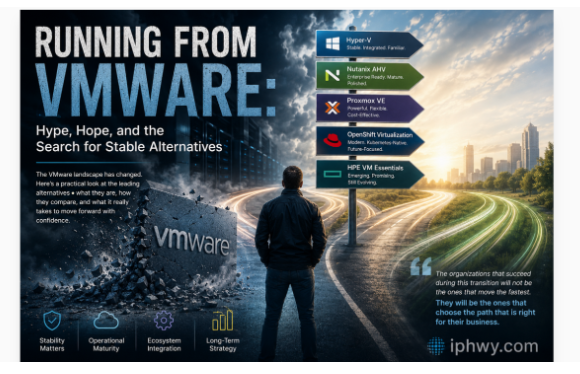

For years, virtualization strategy discussions in enterprise IT were relatively straightforward. Organizations standardized on VMware, built operational processes around it, trained staff around it, integrated monitoring and backup platforms into it, and expected it to remain a foundational layer of enterprise infrastructure for the foreseeable future.
For me, this discussion is also somewhat personal.
I have been working with VMware since its earliest commercial years, dating back to consulting work I performed for a logistics company in Edison, New Jersey that was among VMware’s earliest enterprise customers… likely one of its first ten commercial accounts at the time.
Back then, virtualization itself still felt revolutionary.
The idea that organizations could consolidate workloads, abstract hardware dependencies, improve disaster recovery flexibility, and dramatically change datacenter utilization was transformative for the industry. Over the decades that followed, VMware evolved from an emerging technology into a foundational layer of enterprise infrastructure across countless organizations worldwide.
That long-term perspective matters, because what we are seeing today is not simply organizations replacing one hypervisor with another. It represents a much larger shift in operational philosophy, infrastructure strategy, and enterprise trust.
Then everything changed…
The acquisition of VMware by Broadcom triggered one of the largest waves of infrastructure reassessment the industry has seen in years. Licensing shifts, subscription restructuring, bundled product strategies, and rapidly escalating costs forced many organizations into conversations they never expected to have this soon… “Do we need to leave VMware?”
Suddenly, hypervisor alternatives that had long been considered “interesting,” “experimental,” or “budget-conscious” options were now being discussed in executive meetings, architecture reviews, and datacenter planning sessions worldwide.
And with that shift came an explosion of hype.
Every platform suddenly became “enterprise ready.” Every YouTube channel had the “perfect VMware replacement.” Every lab deployment became proof that migration would be easy.
But in real-world enterprise operations, there is a major difference between a hypervisor working in a lab and a virtualization platform surviving years of operational stress, outages, upgrades, audits, mergers, scaling events, and business continuity incidents.
That distinction matters far more than many organizations initially realize.
News Flash… The Hypervisor Is Not the Hard Part
One of the biggest misconceptions in the current VMware migration frenzy is the belief that virtualization platforms are primarily judged by whether they can successfully run virtual machines. Almost every modern hypervisor can do that. The real challenge is operational maturity. Organizations are not simply replacing a VM engine. They are replacing years, sometimes decades, of accumulated operational integration, process development, administrative familiarity, ecosystem support, and stability engineering.
The difficult questions are not…
- Can it boot a VM?
- Can it create snapshots?
- Can it migrate workloads?
The difficult questions are…
- How stable is clustering under stress?
- How mature is live migration during production load?
- How reliable is storage failover?
- How clean are upgrades?
- How mature is RBAC and audit logging?
- How well does backup software integrate?
- How quickly can operations staff troubleshoot issues?
- How mature is API automation?
- How good is vendor support during a real outage at 2:00 AM?
- How well does it scale operationally after a merger or rapid growth event?
These are the areas where I believe mature enterprise platforms separate themselves from promising alternatives.
So, Why Are Organizations Are Looking Elsewhere?
The reality is simple… many organizations are not leaving VMware because they suddenly dislike the technology itself. In fact, many still consider VMware technically excellent. The concerns are more often tied to:
- cost predictability
- licensing uncertainty
- forced bundling
- changing support models
- reduced flexibility
- long-term strategic trust
For many IT leaders, the problem is no longer technical capability. It is business risk. That’s another distinction that’s important.
Who I See As The Major Contenders
Microsoft Hyper-V (The Safe and Predictable Choice)
Hyper-V is probably the least exciting option being discussed today, and that may actually be its greatest strength. For Windows-heavy enterprises already invested in Active Directory, Microsoft licensing, SQL Server, Azure integration, and PowerShell automation…Hyper-V often represents the lowest operational disruption path.
It is mature, stable, and well understood. It also integrates naturally into many existing enterprise environments.
Does it have every advanced feature or ecosystem advantage VMware built over decades? No.
But for many organizations, Hyper-V is not trying to be revolutionary. It is trying to be dependable. And in enterprise infrastructure, dependable still matters.
Next Up… Nutanix AHV (The Most Polished VMware Alternative)
Among enterprise-focused VMware alternatives, Nutanix AHV has arguably become the strongest direct operational competitor. Nutanix understood early that organizations were not simply buying virtualization. They were buying:
- simplicity
- operational consistency
- centralized management
- integrated storage
- lifecycle orchestration
AHV benefits heavily from Nutanix’s hyperconverged infrastructure approach, where compute, storage, and management are tightly integrated into a unified operational platform. For many enterprises, AHV feels like the closest experience to VMware in terms of operational maturity and polish. The tradeoff, of course, is cost. Nutanix is not the “cheap” option, but many organizations increasingly view it as a lower-risk option.
Well Hello There!
Proxmox VE (The Platform Generating the Most Excitement)
Few platforms have gained as much attention during the VMware disruption as Proxmox. And to be fair, much of that attention is deserved.
Proxmox has evolved significantly over the years…
- KVM-based virtualization
- clustering
- Ceph integration
- container support
- impressive flexibility
- strong value proposition
For labs, smaller businesses, edge deployments, and technically capable Linux-focused teams, it can be an excellent platform. The challenge is that many organizations confuse technical capability with enterprise operational maturity. Those are not the same thing.
Running workloads successfully in production is only part of the equation. The larger concerns involve…
- long-term ecosystem maturity
- enterprise support expectations
- staffing familiarity
- operational tooling integration
- disaster recovery orchestration
- large-scale lifecycle management
None of these are impossible for Proxmox. But they are the areas where enterprises must carefully evaluate risk rather than simply following industry excitement.
Red Hat OpenShift Virtualization (A Future-Focused Strategy)
OpenShift Virtualization represents something larger than a VMware replacement. It reflects the broader industry shift toward platform engineering, Kubernetes-native operations, automation-first infrastructure, and hybrid workload orchestration. Underneath, much of this is still powered by KVM. But the strategic focus is entirely different.
It’s not simply, “How do we virtualize servers?” It’s, “How do we unify virtual machines, containers, automation, and cloud-native operations into a single operational model?”
For organizations heavily investing in DevOps, automation, AI operations, infrastructure-as-code, and Kubernetes ecosystems…OpenShift Virtualization may ultimately represent one of the strongest long-term strategic directions.
I believe the biggest tradeoff is complexity.
It’s not typically the easiest path for traditional IT teams accustomed to classic virtualization management models.
Hewlett Packard Enterprise VM Essentials (The Emerging Player)
HPE’s VM Essentials platform is one of the newer entrants I’ve seen gaining attention as organizations reassess VMware dependency. Like many modern virtualization offerings, it is fundamentally built around KVM-based technologies combined with orchestration, automation, and infrastructure integration layers. I feel what makes HPE interesting is not necessarily the hypervisor itself. It’s HPE’s broader enterprise ecosystem…
- ProLiant infrastructure
- GreenLake
- SimpliVity
- storage integration
- enterprise support relationships
From what I’ve seen so far the platform shows promise, particularly for organizations already deeply invested in HPE infrastructure. However, compared to VMware, Nutanix, or even Hyper-V, VM Essentials still feels early in its maturity lifecycle.
I’m not saying that make’s it bad. It simply means enterprises should evaluate it carefully with realistic expectations.
The Industry Shift
One of the most important realizations emerging from all of this is that the hypervisor itself is becoming commoditized. Increasingly, many platforms are built on similar underlying virtualization technologies… especially KVM.
The true competitive battleground is no longer just virtualization. It’s orchestration, automation, observability, lifecycle management, API maturity, AI-assisted operations, security integration, hybrid cloud portability, and operational simplicity.
In many ways, virtualization is becoming less about the hypervisor and more about the surrounding operational ecosystem. I see that as the real transformation happening right now.
What I’ve Seen Most Enterprises Actually Doing
Despite the dramatic headlines, most organizations are not performing immediate “rip and replace” migrations away from VMware. Instead, many are pursuing hybrid strategies such as reducing VMware dependency gradually, evaluating multiple hypervisors simultaneously, keeping VMware for mission-critical workloads, piloting alternatives in lower-risk environments, modernizing operational tooling first, and preparing for long-term flexibility rather than immediate migration.
To me, this is the most realistic approach. Because infrastructure decisions made out of frustration rarely age well.
The current VMware disruption has forced the industry into an important conversation that was probably overdue. Organizations are now reassessing operational dependence, licensing concentration risk, platform flexibility, and long-term infrastructure strategy.
In enterprise IT, stability is rarely exciting. But the organizations most likely to succeed during this transition will not necessarily be the ones that move the fastest. They will be the ones that understand the difference between feature parity and operational maturity. When critical systems fail, stability is suddenly the only thing anyone cares about.