

Why I Believe Asset Inventory Is Still the Most Important Security Control
For all the attention being paid to artificial intelligence, zero trust, advanced threat detection, and next-generation cybersecurity platforms, one of the most critical security controls remains surprisingly simple…
Knowing what you actually own.
It may not be exciting and it won’t generate headlines. No vendor is likely to invite you to a conference to discuss it. Yet after more than four decades in technology, I continue to see the same problem repeatedly surface in organizations of every size…
Companies are trying to secure environments they don’t fully understand.
And that is where risk begins.
Well, Hello There! The Server Nobody Knew Existed
Every IT professional has a version of this story:
- A vulnerability scan identifies an unknown server.
- An application suddenly stops working after years of operating quietly in the background.
- An employee leaves, and nobody knows who owns a particular system.
- A cloud resource continues running long after the project that created it was abandoned.
- A vendor account still has administrative access years after the contract ended.
That discovery is usually followed by the inevitable question, “Who owns this?”
The silence that follows is often more concerning than the technology itself.
Asset Inventory Is No Longer Just Hardware
Years ago, maintaining an asset inventory was relatively straightforward. Organizations tracked servers, workstations, printers, and network equipment.
Today, an organization’s technology footprint extends far beyond physical devices. Modern asset inventories must account for:
Infrastructure
- Physical servers
- Virtual machines
- Hypervisors
- Storage systems
- Network equipment
- Firewalls
- Load balancers
Cloud Resources
- Virtual instances
- Containers
- Serverless functions
- Storage buckets
- Databases
- Security groups
Applications
- Enterprise software
- SaaS platforms
- Internally developed applications
- Mobile applications
Identities
- User accounts
- Service accounts
- API keys
- Certificates
- Privileged accounts
Data
- Databases
- File shares
- Data lakes
- Backup repositories
In many organizations, these assets are spread across multiple departments, vendors, cloud providers, and business units. Without visibility, governance becomes nearly impossible.
The Security Team Cannot Protect Unknown Assets
One of the most common assumptions executives make is that security teams can somehow monitor everything. The reality is much different. Security tools only protect what they know exists.
If a system isn’t:
- Monitored
- Managed
- Scanned
- Patched
- Documented
Then it effectively becomes invisible.
Attackers understand this. That’s why in many breaches, the initial entry point isn’t a heavily protected system. It’s often:
- An abandoned server
- An outdated web application
- An unused VPN account
- A forgotten cloud workload
- An overlooked third-party integration
The weakest point in the environment is rarely the most important system. It’s usually the one nobody remembered.
The Cost That Goes Well Beyond Security
Poor asset inventory isn’t just a cybersecurity issue. It’s a business issue. Organizations frequently discover they are paying for:
- Unused software licenses
- Dormant cloud resources
- Duplicate monitoring platforms
- Redundant SaaS subscriptions
I’ve seen environments where multiple departments purchased similar tools independently because nobody had visibility into what was already available. The result is increased costs, complexity, support burden, and risk. A strong asset inventory improves security, but it also improves operational efficiency and financial management.
That should matter to every executive.
Ownership Is More Important Than Discovery
Many companies focus on discovering assets. While that is important, discovery alone is not enough. Every asset should have…
- A business owner
- A technical owner
- A support contact
- A security classification
- A documented purpose
Without ownership, inventory quickly becomes a list rather than a management tool. And unmanaged assets eventually become unmanaged risks.
Asset Inventory Is the Foundation of Every Security Program
Organizations often ask me where they should begin when improving cybersecurity. My answer is rarely a new tool. It typically begins with visibility.
Before you can:
- Patch systems
- Manage vulnerabilities
- Enforce compliance
- Implement Zero Trust
- Secure cloud environments
- Protect sensitive data
You must first answer a simple question… “What do we have?”
While it sounds basic, many organizations cannot answer it with confidence.
Technology continues to evolve at an incredible pace. Artificial intelligence, cloud computing, automation, and advanced security platforms are transforming the way organizations operate.
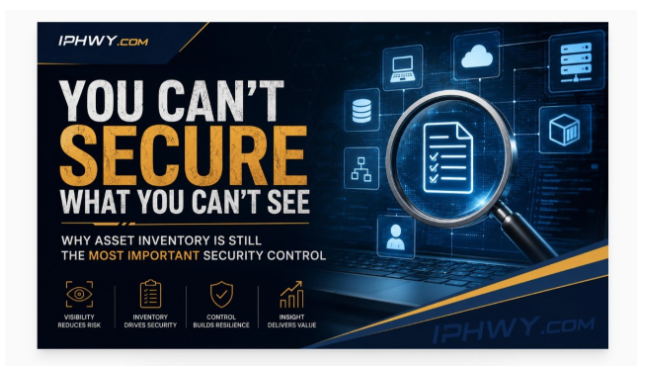
But the fundamentals have not changed. You cannot patch what you don’t know exists. You cannot monitor what you cannot see. You cannot secure what you cannot inventory.
The most dangerous asset in your environment may not be the one generating alerts. It may be the one nobody remembers is there. And that’s exactly why I believe asset inventory remains one of the most valuable security controls an organization can implement.