


When Artificial Audiences Become Indistinguishable from Real People
In 1978, Memorex launched one of the most recognizable advertising campaigns of its era.
The premise was simple. A recording was played back through a speaker with such fidelity that listeners could not tell whether they were hearing a live performance or a recording.
The tagline became iconic…
“Is it live, or is it Memorex?”
Nearly fifty years later, we may be facing a far more consequential version of the same question. Only this time, it isn’t music… It’s people.
The Rise of the Artificial Audience
For years, organizations have battled fake social media accounts, click farms, and engagement fraud. Most executives viewed these activities as nuisances rather than strategic threats. A fake “like” here. A fake view there. An occasional spam account.
The assumption was that platforms would eventually identify and remove the bad actors. But something fundamental has changed. The combination of artificial intelligence, automation, and increasingly sophisticated simulation technologies is creating an entirely new challenge…
Artificial audiences.
Not just fake accounts or bots. Entire populations of digital entities designed to appear, behave, and interact like real human beings.
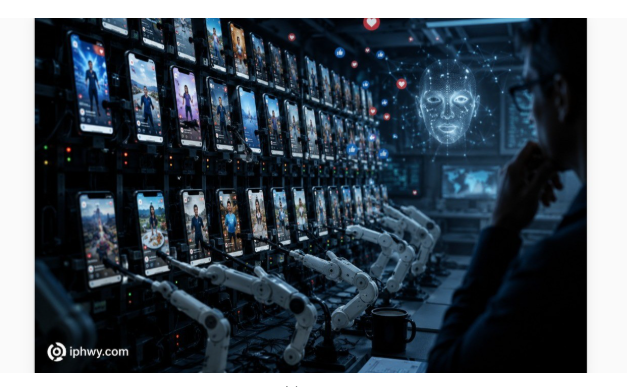
The New Phone Farm
Recent demonstrations have shown large-scale robotic phone farms operating hundreds or thousands of mobile devices simultaneously. Mechanical systems physically tap screens, scroll content, watch videos, and interact with applications around the clock. At first glance, it seems almost absurd. Rows of smartphones mounted in racks while robotic arms endlessly swipe and click. But the robotics aren’t the interesting part, the intelligence behind them is.
Modern AI systems can now…
- Vary scrolling speeds.
- Simulate attention spans.
- Introduce realistic pauses.
- Generate comments.
- Mimic human browsing patterns.
- Coordinate activity across thousands of devices.
- Adapt behavior as platforms evolve.
The objective is no longer simply generating traffic. The objective is generating believable traffic.
The Problem Isn’t the Bot
Historically, platforms focused on identifying fake accounts. But what happens when the account itself appears legitimate? Or, what happens when the behavior and engagement patterns appear legitimate? The challenge shifts from identifying fake users to proving authenticity. And that is a much harder problem.
Increasingly, the question is not, “Is this account a bot?” The question becomes, “Can we prove this interaction came from a human being?”
The Economics of Deception
Most modern digital platforms are built on engagement. Views, clicks, comments, shares, watch time, recommendations, and advertising impressions. The value of these metrics assumes one critical condition… That they represent genuine human interest!
If a significant percentage of engagement originates from automated systems, the integrity of those metrics begins to erode. Creators cannot accurately measure audience interest. Advertisers cannot accurately measure campaign effectiveness. Businesses cannot accurately assess market sentiment. Investors cannot accurately evaluate platform performance.
At scale, artificial engagement becomes more than a technical issue, it becomes an economic issue.
A Real Trust Crisis
For years, most cybersecurity professionals have focused on protecting identities, verifying users, securing credentials, and preventing unauthorized access. But we may be approaching a future where the larger challenge is proving that a user is human at all. The internet was built on the assumption that people represented the majority of activity and that assumption may no longer be safe.
Some industry estimates suggest that automated traffic already accounts for a substantial percentage of internet activity. While the exact number remains debated, the trend itself is not. Machine-generated activity continues to grow, and AI is accelerating that growth dramatically.
Beyond Social Media
The implications extend far beyond social platforms. Artificial engagement influences…
- Product reviews.
- Consumer sentiment.
- Political discourse.
- Market research.
- News distribution.
- Search rankings.
- Financial markets.
Even professional networking platforms like LinkedIn are not immune. Executives should ask themselves a simple question, “How many of the interactions influencing my decisions today originated from real people?”
Increasingly, the answer may be less certain than we would like.
The New Memorex Question
The original Memorex campaign celebrated a technological achievement. A recording so realistic that it became difficult to distinguish from reality. Today’s challenge is far more complex. We are building systems capable of imitating not just voices, but behavior.
Not just the content, but participation. Not just the communication, but communities.
The question facing businesses, platforms, regulators, and society is no longer whether machines can mimic humans. That question has largely been answered. The question now is whether we can still reliably tell the difference. Because in an AI-driven world, the most important question may no longer be…
“Is it live, or is it Memorex?”
It may be…
“Is it human?”