

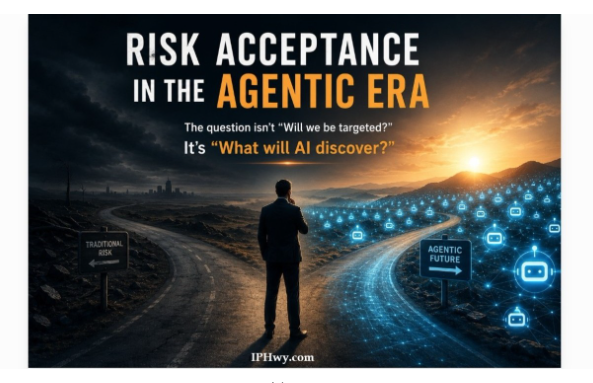

Why AI Forces Us to Rethink One of Cybersecurity’s Oldest Assumptions
For decades, cybersecurity professionals have relied on a familiar framework when making difficult security decisions.
- We identify a risk.
- We determine the likelihood of that risk occurring.
- We evaluate the potential business impact.
- We compare that against the cost of mitigation.
Then, if the business determines the remaining exposure is acceptable, we document the decision and move forward.
Every organization does it. Whether formally documented in an enterprise risk register or discussed around a conference table, the conversation almost always begins with the same question… “What are the odds this actually happens to us?”
For years, that was a perfectly reasonable question. In fact, it was one of the most important questions we could ask. But I believe we’re entering an era where that assumption deserves to be challenged. Not because risk management is broken, and not because risk acceptance no longer matters. But because one of the variables we have historically depended upon… likelihood… is being fundamentally reshaped by Agentic AI.
The Probability We ‘Thought’ We Understood
Traditional risk acceptance was never about eliminating risk. It was about making informed business decisions. No organization has unlimited budgets, unlimited personnel, or unlimited time. Security has always been an exercise in prioritization.
Every security leader has heard some variation of these questions…
- “Do we really need to fix this?”
- “How likely is someone to exploit it?”
- “What’s the real-world chance we’ll be targeted?”
- “Can we accept this until next quarter?”
Those questions made sense because attackers themselves operated under constraints.
- They had limited time.
- Limited resources.
- Limited expertise.
- Limited infrastructure.
- Limited personnel.
- Every attack represented an investment.
- Every reconnaissance effort consumed time.
- Every phishing campaign required planning.
- Every exploit required research.
An attacker had to decide where to spend their effort because they couldn’t realistically pursue everyone. Probability meant something because human attackers were forced to make choices.
Scarcity Was Built Into the Equation
Traditional risk models depended on something groups rarely discussed… Scarcity.
- There was only so much an attacker could do in a day.
- Only so many organizations they could investigate.
- Only so many phishing emails they could personally craft.
- Only so many vulnerabilities they could manually chain together.
Even well-funded nation-state actors had operational limits, and that scarcity naturally reduced probability.
Many organizations weren’t secure because they were well protected. They were secure because they simply weren’t worth an attacker’s time. That truth is one that our industry has quietly benefited from for decades.
Agentic AI Changes the Economics
Agentic AI doesn’t simply make attackers faster. It changes the economics of attacking altogether.
Instead of manually researching a target, autonomous agents can continuously enumerate internet-facing infrastructure.
Instead of writing one phishing email, they can generate tens of thousands of personalized messages, each tailored to the recipient’s role, interests, communication style, and publicly available information.
Instead of manually reviewing vulnerabilities, they can correlate exposures across cloud platforms, identity providers, SaaS applications, Git repositories, leaked credentials, DNS records, social media, and threat intelligence feeds simultaneously.
Instead of waiting for human direction, autonomous agents can iterate, adapt, prioritize, and continue operating around the clock.
The important point isn’t that AI makes attacks more sophisticated. It’s that AI dramatically reduces the cost of attacking another organization.
Historically, every additional target required additional effort. Now, evaluating another organization may require almost none. And in my opinion, that changes everything.
We May Be Asking the Wrong Question
For decades many C-Suites asked… “What are the odds someone attacks us?”
In an agentic world, perhaps the better question is… “What are the odds autonomous systems never evaluate us?”
Those are two entirely different probabilities.
Traditional risk acceptance assumed there was a human decision somewhere in the attack chain.
- Someone had to choose your organization.
- Someone had to decide you were worth pursuing.
- Someone had to allocate time and resources.
Agentic AI doesn’t think that way.
- It doesn’t become bored.
- It doesn’t get distracted.
- It doesn’t work eight-hour shifts.
- It doesn’t need weekends.
- It doesn’t ask whether your organization is “interesting enough.”
It simply continues evaluating.
- Continuously.
- Indefinitely.
- And…at machine speed!
Exposure Becomes the New Probability
I believe one of the biggest mental shifts security leaders need to make is recognizing that exposure is increasingly replacing intent as the primary driver of probability.
Historically, organizations often asked…
- What’s the likelihood someone discovers this?
- What’s the chance someone targets us?
- Are we important enough?
Those questions made sense when discovery itself was expensive. Today, discovery is becoming increasingly automated. Instead, we should be asking different questions:
- How visible are we?
- What can autonomous systems learn about us in minutes?
- What attack paths can AI correlate across our environment?
- How quickly could an agent identify privilege escalation opportunities?
- How long would it take an autonomous adversary to weaponize publicly available information?
Notice what changed. We’re no longer estimating human intent. We’re measuring discoverability.
Risk Acceptance or Exposure Acceptance?
This may sound like semantics, but I don’t believe it is. When organizations document a risk today, they often state…“The organization accepts the residual risk.”
But what are we really accepting?
Increasingly, we are accepting that autonomous systems will almost certainly discover the condition. That realization changes the conversation. Perhaps we’re no longer simply practicing risk acceptance. Perhaps we’re now practicing exposure acceptance.
That subtle change in language forces different questions. Instead of saying, “We’re comfortable with the likelihood.” We’re effectively saying,“We’re comfortable remaining continuously discoverable by autonomous adversaries.”
Those statements carry very different weight.
Why Governance Must Evolve !
This evolution doesn’t only affect security teams.
- It affects boards.
- Executives.
- Audit committees.
- Risk committees.
- Enterprise governance.
Traditional board discussions often revolve around probability…“How likely is this?”
In an agentic environment, that conversation must evolve into something more useful… “How quickly could intelligent systems identify and exploit this?”
- Time-to-discovery.
- Time-to-exploitation.
- Time-to-containment.
Those may become more meaningful measurements than subjective estimates of attacker likelihood.
Let’s be clear. Organizations will always accept risk. Nor should they stop. Every business operates within financial realities, and perfect security has never existed. Honestly, it never will.
Risk acceptance remains a necessary discipline. But the assumptions informing those decisions deserve reexamination.
- If AI dramatically reduces the cost of reconnaissance…
- If autonomous systems continuously enumerate exposed infrastructure…
- If personalized attacks become essentially free…
Then our historical estimates of likelihood may no longer reflect reality. The equation itself hasn’t changed. Risk still equals likelihood multiplied by impact. What has changed is how we calculate likelihood.
The Next Evolution of Risk
For years, cybersecurity professionals have understood that technology evolves faster than policy. I believe we’re witnessing another one of those moments. Agentic AI isn’t simply introducing new attack techniques. It’s challenging one of the oldest assumptions behind enterprise risk management, that attackers are constrained enough for probability to remain relatively stable. Those constraints are disappearing. And as they do, our models must evolve alongside them.
That, in my opinion, is the defining challenge of cybersecurity in the Agentic Era.