

When Enterprise Software Became an Infomercial
Remember those infomercials?
You’d be half asleep watching television when suddenly someone appeared with a product capable of changing civilization as we knew it.
Maybe it sliced tomatoes.
Maybe it removed scratches from your car.
Maybe it caught fish.
Whatever it did, one thing was certain…
You weren’t getting just one.
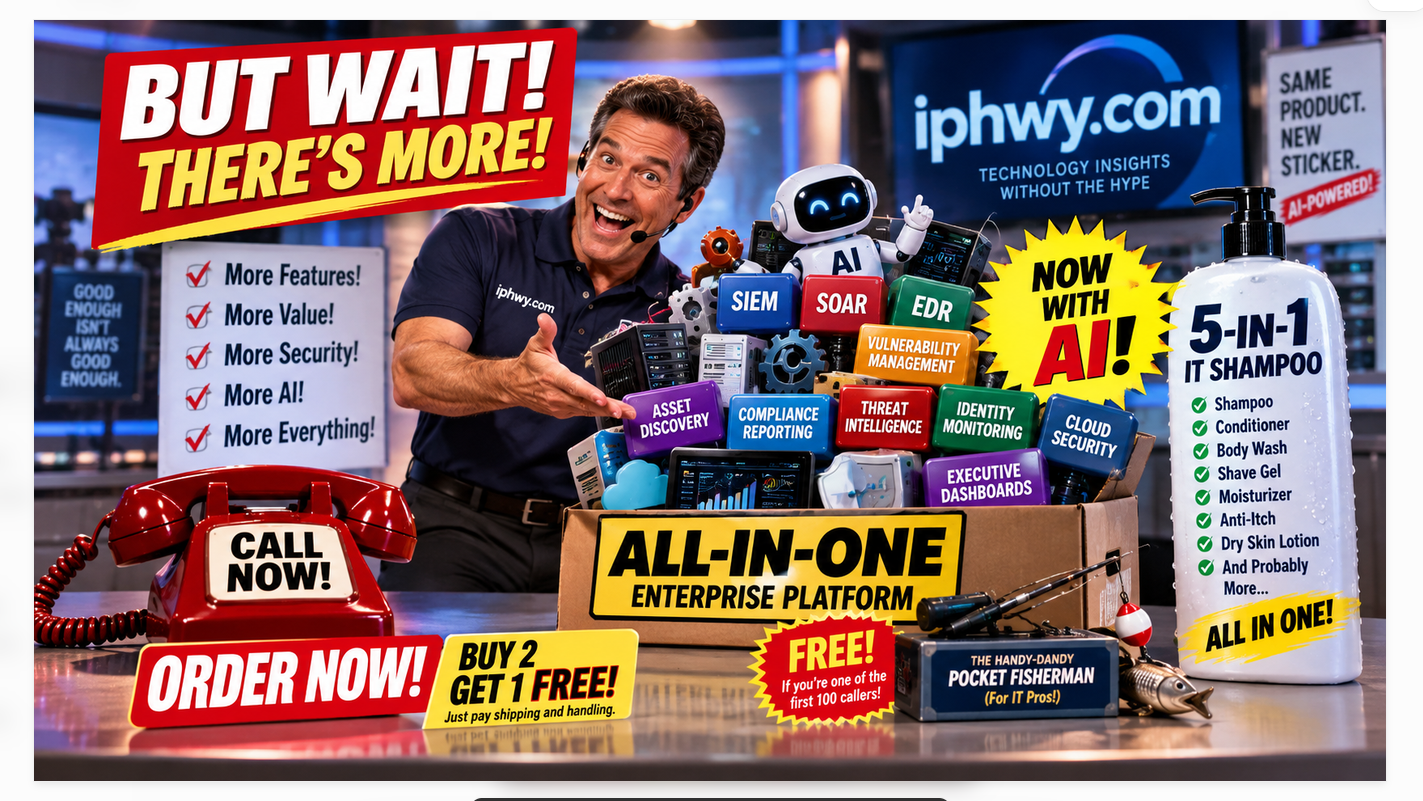
“But wait! There’s more!”
Order in the next 30 minutes and they’d send you TWO!
Be one of the first 100 callers and they’d throw in the Handy-Dandy Pocket Fisherman.
Order two and they’d give you a third ABSOLUTELY FREE!
You just pay separate shipping and handling.
Then came the magic question:
“Now… how much would you expect to pay?”
Apparently, somewhere along the way, enterprise software hired the same marketing department.
BUT WAIT! IT ALSO DOES SOAR!
Spend some time looking at IT and cybersecurity products today and you’ll recognize the formula.
It starts simply enough…
“We’re a SIEM.”
Great. I need a SIEM.
BUT WAIT!
It also does SOAR!
Okay…
BUT THAT’S NOT ALL!
It includes vulnerability management!
Asset discovery!
Compliance reporting!
Attack-surface management!
Threat intelligence!
Executive dashboards!
Cloud security!
Identity monitoring!
And if you sign before the end of the quarter…
WE’LL THROW IN AI!
Absolutely free!*
*AI credits, data ingestion, retention, premium connectors, professional services, API calls, implementation and the feature you actually wanted may require additional licensing.
We’ve somehow turned enterprise software into an infomercial.
The 5-in-1 Shampoo Problem
This isn’t limited to technology.
We’ve already perfected this strategy in the shampoo aisle.
At some point, shampoo stopped being shampoo.
Now it’s:
Shampoo + Conditioner + Body Wash + Face Wash + Shaving Gel + Moisturizer + Anti-Itch Treatment + Dry-Skin Lotion
ALL IN ONE!
I’m pretty sure one more product cycle and you’ll be able to clean your shower grout with it.
And there’s nothing inherently wrong with convenience.
I understand the appeal.
One bottle. Less clutter. Less money. Fewer things to buy. Perceived VALUE!
But eventually I find myself staring at that bottle wondering…
Is this actually great at any of those things?
And that’s increasingly how I feel looking at enterprise technology platforms.
Whatever Happened to Being the Best at Something?
There was something wonderfully simple about a company saying:
“This is what we do, and we’re really good at it.”
The best monitoring product.
The best firewall.
The best backup platform.
The best vulnerability scanner.
The best endpoint protection.
The best ticketing system.
You bought the product because the company had spent years obsessing over a particular problem.
Then something changed.
Monitoring companies became security companies.
Security companies became observability companies.
Backup companies became cybersecurity companies.
Cybersecurity companies became asset-management companies.
Asset-management companies became vulnerability-management companies.
Vulnerability-management companies became cloud-security companies.
And eventually…
Everybody became an AI company. 😉
Today you can sometimes sit through a product demonstration for 45 minutes and still not be entirely sure what the company originally made.
And Then AI Arrived
AI poured rocket fuel on the whole thing.
And I want to be clear about something. There are fantastic uses of AI happening right now.
There are products being genuinely transformed by it. There are capabilities possible today that would have been extraordinarily difficult only a few years ago.
That’s exciting. But there’s also another category.
Same product. New sticker.
Search becomes…
AI-Powered Intelligent Discovery.
A correlation rule becomes…
AI-Driven Threat Analysis.
A summary becomes…
Generative Incident Intelligence.
An automated workflow becomes…
Autonomous AI Remediation.
And sometimes somebody attaches a chatbot to the right side of an application and suddenly…
THE ENTIRE PLATFORM IS AI-POWERED!
There are moments when I want to look underneath the hood and ask:
“Guys… isn’t this the same button?”
Introducing –> Feature Camouflage
There’s an important difference between a product naturally expanding and one simply accumulating features.
One sounds like this..
We are excellent at X. Our customers also need Y. Integrating Y deeply into X makes the entire product better.
Perfect. Now, that’s innovation. That’s platform evolution. And yes, that’s added value.
The other sounds more like:
We’re having trouble differentiating X, so we’ve added Y, Z, compliance, automation, asset management, reporting, AI and fourteen dashboards.
That’s different, and I have a name for it:
Feature Camouflage.
If you put enough checkmarks on the comparison sheet, maybe nobody spends too much time examining the checkmarks that actually matter.
And that’s where “look at everything it does” quietly replaces “look how well it does it.”
Welcome to the Era of “Good Enough”
For decades, enterprise IT debated…
Best-of-breed or integrated platform?
It’s still a legitimate debate.
But I think we’ve quietly introduced a third option…
Good-enough-of-everything.
Maybe Platform A isn’t the best EDR.
Its vulnerability management isn’t quite as strong as another vendor.
Its reporting isn’t fantastic.
Its SIEM isn’t your first choice.
Its automation is okay.
Its AI assistant occasionally answers your question with the technological equivalent of a confident shrug.
But…
It’s already licensed.
It’s already deployed.
It’s already collecting the data.
And it’s all in the same console.
So we say, “Eh… it’s good enough.”
Sometimes that’s actually the correct business decision.
But we should at least recognize that we’re making it.
To Be Fair, Consolidation Has Real Value
I’m not arguing that everyone should run 73 different point solutions.
I’ve worked in environments where you practically needed a dashboard just to remember where all the other dashboards were.
Complexity has a cost.
Every additional product potentially means another:
- Agent
- Console
- Contract
- Renewal
- Integration
- API
- Credential
- Training requirement
- Support relationship
- Data repository
Consolidation can absolutely make sense.
If one platform gives me 90% of the functionality of several separate products while dramatically reducing cost and complexity, I may happily take the 90%.
That’s not settling.
That’s making an architectural and business decision.
But consolidation should be a conscious tradeoff, not an automatic assumption that more features equal more value.
Here’s the Question I Typically Ask Vendors
Instead of asking…
“How many things does your platform do?”
I Ask…
“How many of those things would I buy from you if they weren’t included?”
That’s a much more interesting question.
If I were independently shopping for vulnerability management, would I buy yours?
If I needed a SIEM, would you make my shortlist?
Would I choose your EDR?
Your monitoring?
Your asset management?
Your backup?
Your AI assistant?
If the answer keeps becoming, “Well… probably not. But it’s included.”
Maybe that’s worth examining.
Because included and valuable are not the same thing.
And available certainly doesn’t mean best.
Convenience May Be Becoming the Product
Perhaps that’s the bigger transformation.
We’re not always buying the best technology anymore.
Sometimes we’re buying:
The least inconvenient collection of technology.
- One contract.
- One agent.
- One console.
- One vendor.
- One renewal.
- One throat to choke… as the old saying goes.
And there’s genuine value in that. But convenience can quietly become the primary feature.
At some point, the reason we’re using Product X isn’t necessarily because Product X is exceptional.
It’s because Product X was already included with Products A through W.
That’s when I think technology leaders should occasionally stop and ask…
If we were starting from scratch today, would we still choose this?
I feel that’s a very powerful question.
Best-of-Breed Has Become Best-of-Bundle
Maybe that’s the new enterprise technology debate.
It’s no longer… Best-of-breed vs. single vendor.
It’s become… Best-of-breed vs. best-of-bundle.
And there isn’t one correct answer. Some organizations absolutely benefit from deeply integrated platforms. Others need specialized tools because certain capabilities are too important to compromise.
Most will live somewhere in the middle.
The danger isn’t choosing a bundle. The danger is assuming that because something came in the bundle, it’s automatically the right tool for the job.
Sometimes it is… But sometimes it’s just the free steak knives.
Maybe We Need Fewer Features and Better Products
Technology vendors obviously want larger footprints, while customers want better value.
Finance wants fewer contracts, while IT wants fewer platforms.
Security wants better visibility, while executives want lower costs.
Sales always wants the deal signed before quarter-end.
I understand exactly how we got here. But I hope we don’t lose something valuable along the way…
Specialization.
There’s something refreshing about a product that knows exactly what it’s supposed to do, and does it exceptionally well.
- Not 47 modules.
- Not twelve dashboards.
- Not an AI assistant because everybody else has one.
- Not another capability somebody assures me I’ll appreciate someday.
Just a really great product solving a real problem exceptionally well.
Because sometimes I don’t need shampoo, conditioner, body wash, shaving cream, moisturizer, anti-itch treatment and tire cleaner in the same bottle.
Sometimes I just want really good shampoo.
And sometimes…
I just want the best damn firewall.
No AI-powered Pocket Fisherman required.
Although if you call within the next 30 minutes, we’ll throw in two absolutely free.
You just pay shipping, handling, licensing, implementation, ingestion, storage, professional services and annual maintenance.