

When security updates arrive before the full explanation, the real test is how leadership and engineering teams make the decision together.
That firewall is carrying production traffic, and the next maintenance window is days away. The firewall vendor reaches out and says the security update needs immediate attention.
The Twist? …. The detailed advisory is still weeks out.
Your network engineer asks what could break. Your security lead asks how long you can afford to wait. Your business leader asks whether this really requires an emergency change.
All completely reasonable questions.
The tough part is that a decision may be necessary before anyone can answer them completely.
On October 21, Fortinet announced coordinated security updates scheduled for October 22 for FortiOS, FortiManager, and FortiAnalyzer, alongside recent FortiMail and FortiAuthenticator releases. The company described critical and high-severity fixes, urged prompt upgrades with internet-facing devices first, and scheduled public advisories for November 10. It attributed some findings to AI-assisted testing and warned about attackers analyzing patches to identify weaknesses.[1]
That gap between an available fix and a detailed explanation creates a difficult operating environment. Customers must weigh a concrete change against an incompletely understood threat.
For leadership teams, the question becomes… How much evidence is enough to authorize action?
For engineering teams… How do we make that action controlled, recoverable, and verifiable?
When waiting belongs on the risk register
Organizations understand the risk of making a change. A failed upgrade can interrupt customer connectivity, break integrations, affect remote access, or leave a critical system unreachable.
Any engineer raising those concerns is doing their job.
But postponing an update also changes the organization’s risk position when the system stays on vulnerable software while the patch becomes available for others to inspect.
Patch diffing means comparing old and new software to locate changes. A patch can therefore provide clues about the weakness it repairs. That does not prove an exploit exists for a particular release. It does mean that the publication date of a detailed advisory is a poor substitute for an assessment of exposure.
“We’ll wait for more information” needs an owner, a deadline, and a reason. Otherwise, uncertainty quietly becomes permission to do nothing.
An emergency change shortens the calendar
Urgency puts pressure on every safeguard that makes infrastructure changes survivable.
That is precisely when I believe a team needs a small set of questions it can answer quickly…
- Which affected products and versions do we actually run?
- Which services and management interfaces can untrusted systems reach?
- What dependencies or upgrade prerequisites could make the change fail?
- Can we recover if the device becomes unreachable?
- What will demonstrate that the business service works afterward?
A configuration backup helps. So does knowing that the backup is accessible when the appliance, management platform, or authentication service is unavailable.
A high-availability pair helps. So does verifying its health and the supported upgrade sequence before relying on it to preserve service.
A rollback plan helps. So does understanding whether a downgrade is supported, what configuration changes it may reverse, and how returning to a vulnerable release affects the security decision.
All practical engineering questions. Leadership teams should make room for them.
“Patch tonight” is an instruction. A named operator, an approved path, recovery access, and agreed success criteria make it an executable decision.
Give leadership a decision it can actually make
Technical teams often bring executives a severity rating and a request for downtime. However, those executives need the connection between the two.
A useful briefing explains the business service at risk, the exposure that makes the update urgent, the disruption the change could cause, and the controls available if the organization delays.
For example, an illustrative decision might read –>
We recommend updating the affected edge devices during tonight’s emergency window. A failed upgrade could interrupt customer connectivity. The team has checked the upgrade path, confirmed recovery access, and prepared service validation. Delaying leaves the affected systems on their current software; any deferral should identify the temporary exposure controls, accountable owner, and next review time.
That paragraph does not eliminate uncertainty, but it does makes the tradeoff visible.
Executives should not have to infer business impact from a firmware release number. An engineer should not have to guess whether the organization has accepted the consequences of waiting.
Remember…. “Fixed” has to survive a customer transaction
A successful installation is only one part of a successful change.
The device may boot while routing behaves differently. Authentication may succeed for administrators while failing for remote users. A management console may look healthy while logs stop reaching the SOC.
Validation should follow the service through ALL its dependencies… connectivity, routing, VPN access, authentication, policy behavior, integrations, and security telemetry, as applicable.
Record the installed version. Test the paths that matter. Confirm that monitoring can still see the environment.
And keep remediation separate from investigation. Updating software does not establish whether someone previously exploited it. Evidence of suspicious access requires its own response.
The change only closes when the intended protection is in place and the service has been verified.
Vendors owe customers usable uncertainty
Customers can accept that publishing exploit details too early may create additional risk. They still need enough information to make defensible decisions.
Affected versions, exposure conditions, upgrade prerequisites, supported mitigations, exploitation status where known, and clear update channels all help customers act responsibly.
When details must be withheld, vendors should explain what is known, what remains uncertain, and when the next update will arrive.
The burden cannot fall entirely on customers to translate “urgent” into a safe production plan.
Will the next advisory test decisions already made? Yes!
When an urgent patch arrives, the response will expose the organization’s existing arrangements… who knows the assets, who can authorize downtime, who can recover a failed device, and who can accept a delay.
Those arrangements are difficult to invent during an emergency.
Leadership can establish authority before the next advisory. Engineers can prepare upgrade and recovery procedures before the next maintenance window. Security teams can connect exposure to business impact before the next severity score demands attention.
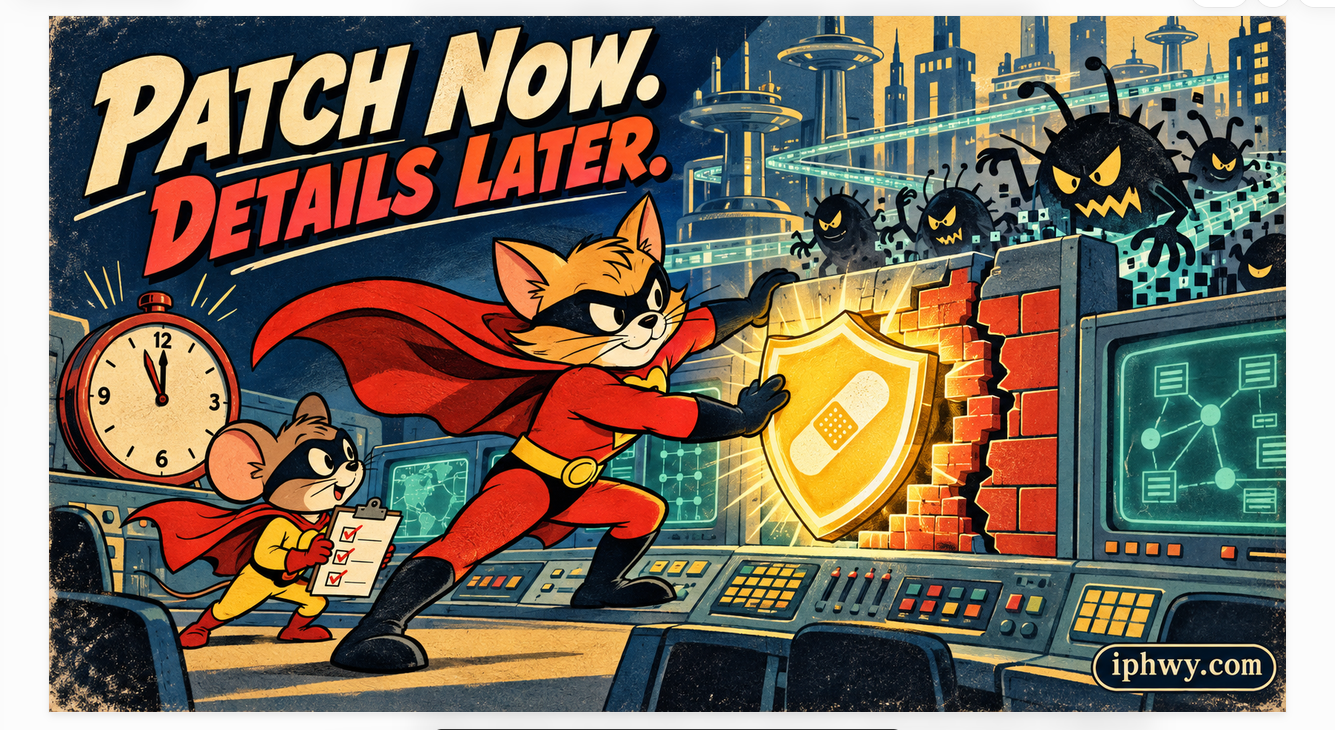
The next time a vendor says “patch now, details later,” someone will ask whether there is enough information to act. Someone should also ask, What evidence makes waiting the safer decision… and who is accountable for that call?
[1] Fortinet, Carl Windsor, October 21, 2026–> Fortinet Releases Security Hardening Release for Multiple Products. Announcement details checked October 27, 2026. Operational recommendations and analysis are the author’s.