

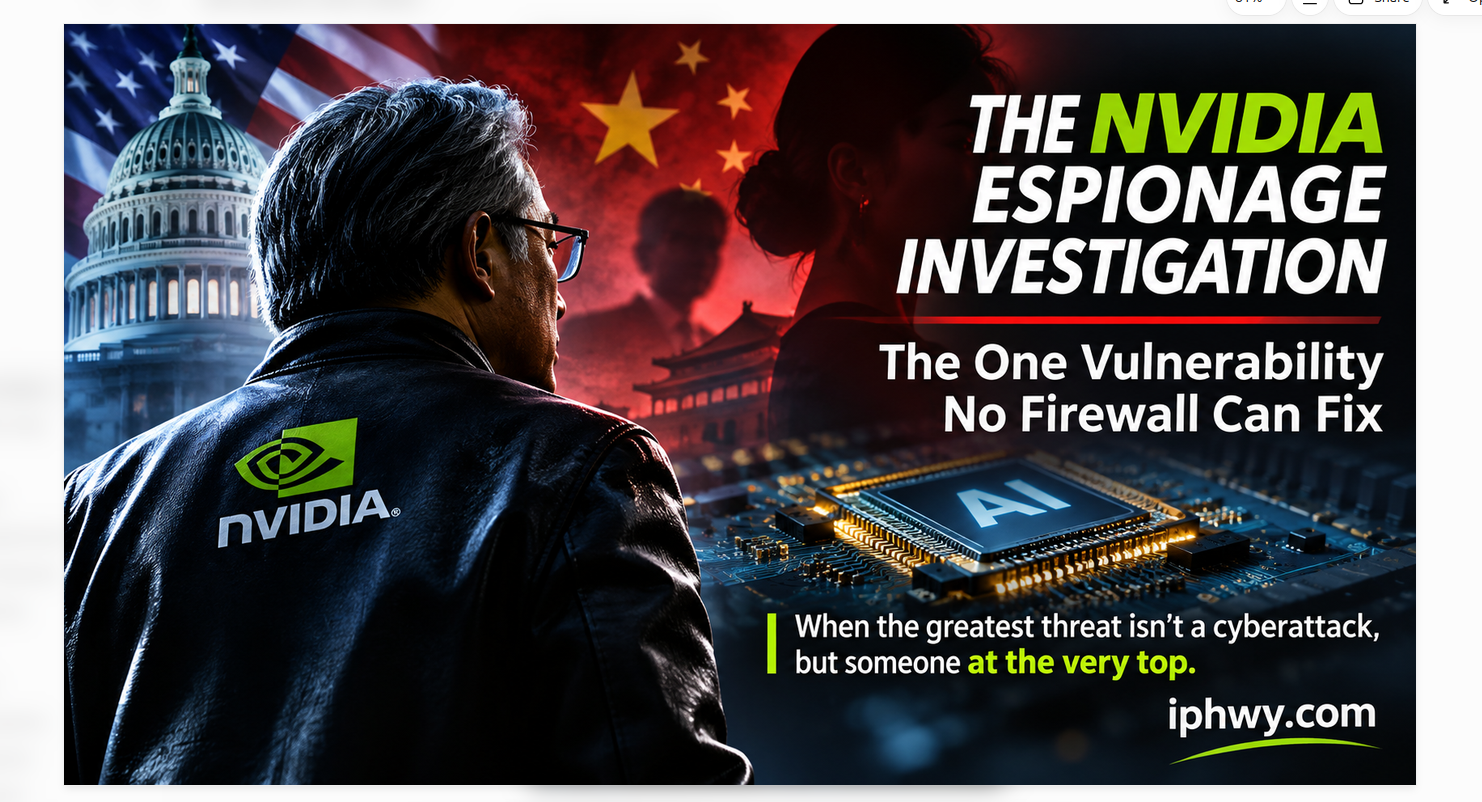

The NVIDIA Espionage Investigation Raises a Disturbing Question About Corporate Security, Executive Leadership, and the Human Element
What if the greatest threat to one of the world’s most technologically advanced companies didn’t come through a firewall, a compromised server, or a sophisticated cyberattack?
What if it came through a personal relationship? No malware, ransomware, stolen credentials, or zero-day exploit.
Just trust.
And potentially, someone who knew exactly how to exploit it.
That is the question emerging from the extraordinary allegations surrounding NVIDIA CEO Jensen Huang, a suspected Chinese intelligence operative, and an investigation that now reaches into the highest levels of corporate leadership and American national security.
The story has all the elements of an international espionage thriller.
A powerful technology executive. A mysterious business relationship. Allegations of foreign intelligence involvement. Billions of dollars in strategically important technology. And now, an independent investigation by the board of one of the most influential companies in the world.
Except this one isn’t fiction, and the implications extend far beyond NVIDIA.
A Relationship That Became a National Security Concern
Today, NVIDIA’s board of directors announced an independent investigation following reports that its founder and CEO, Jensen Huang, had been targeted by a foreign intelligence operation.
The announcement followed reporting about Huang’s relationship with Alice Huang, a former executive at Singapore-based Megaspeed, a company that purchases NVIDIA’s advanced AI chips.
According to reporting by The New York Times and other news organizations, U.S. authorities suspect Alice Huang was recruited by China’s Ministry of State Security to collect information concerning NVIDIA and potentially influence decisions involving advanced semiconductor technology.
The allegations have not been established through the announced corporate investigation. China has rejected the espionage accusations.
Jensen Huang has acknowledged an extramarital relationship and publicly apologized to his family, colleagues, and shareholders.
But the personal scandal is not the most important aspect of this story.
The more consequential question is whether a foreign intelligence service attempted to exploit a personal relationship to gain access to information, influence, or strategic advantages involving one of America’s most important technology companies.
NVIDIA’s board has emphasized that it currently has no reason to believe company secrets or national security were compromised. Huang has committed to cooperating with the independent investigation.
Of course, an allegation of espionage is not proof of a successful intelligence operation. And a personal relationship, however controversial, is not itself evidence that confidential information was disclosed.
Nevertheless, the situation raises questions that every technology executive should be asking.
Because if the allegations ultimately prove accurate, they would illustrate something cybersecurity professionals have understood for decades… Sometimes the easiest way into a highly secured organization isn’t through its technology… It’s through its people.
The Most Valuable Target May Not Be a Server
Consider the extraordinary position NVIDIA occupies in today’s technology landscape.
Its processors power much of the infrastructure behind modern artificial intelligence.
Its technology supports advanced research, scientific computing, enterprise AI deployments, and applications with significant national security implications.
Its commercial relationships and product decisions influence the direction of an industry increasingly central to global economic and geopolitical competition.
And at the center of that ecosystem sits its founder and CEO.
An individual with access to strategic plans, technology roadmaps, sensitive commercial relationships, and conversations with some of the most powerful business and government leaders in the world.
From an intelligence perspective, the potential value of access to someone in that position is enormous.
Now consider how organizations traditionally approach security.
- We protect networks with firewalls.
- We protect identities with multifactor authentication.
- We protect endpoints with sophisticated detection and response platforms.
- We protect sensitive data through encryption, access controls, monitoring, and increasingly advanced security architectures.
- We invest millions identifying vulnerabilities and reducing attack surfaces.
Yet an executive’s personal relationships, professional networks, travel, and informal communications may create exposures that conventional cybersecurity tools cannot adequately address.
A firewall cannot determine whether a personal relationship is being cultivated for intelligence purposes.
Endpoint detection cannot reliably identify emotional manipulation.
And multifactor authentication cannot prevent someone from voluntarily sharing information with a person they trust.
Technology can protect access to information, but it cannot independently determine whether someone is being manipulated into sharing it.
That is a fundamental challenge.
The Intelligence Playbook Is Older Than Cybersecurity (Tale as old as time)
Foreign intelligence services have spent generations developing methods to obtain information without breaking into buildings or computer systems.
One well-known technique involves cultivating personal relationships to gain trust, access, or influence.
Sometimes referred to as a honey trap, the method may involve romantic or intimate relationships, although intelligence recruitment and influence operations can also exploit friendship, financial interests, professional ambitions, ideological beliefs, or personal vulnerabilities.
The objective is not necessarily to steal a document immediately. It may be to:
- Establish access.
- Build credibility.
- Develop dependence.
- Understand motivations.
- Learn who influences decisions.
And potentially shape those decisions over time.
This is what makes human intelligence operations fundamentally different from conventional cyberattacks.
- A malicious attachment can be analyzed.
- An unauthorized login can generate an alert.
- Suspicious network traffic can be investigated.
But how does a security operations center detect a conversation over dinner?
How does an organization distinguish a legitimate business relationship from a carefully cultivated intelligence operation?
And at what point does an executive’s private conduct become a matter of corporate security?
These questions are difficult precisely because they sit at the intersection of privacy, personal judgment, corporate responsibility, and national security.
The answer cannot simply be to monitor executives’ private lives.
But neither can organizations assume that senior leadership is somehow immune to the social engineering risks routinely addressed in employee security awareness programs.
The higher the position, the greater the potential consequences of a successful compromise.
What If the Objective Wasn’t to Steal Anything?
There is another dimension to this story we must remember…
When we hear the word espionage, we often imagine stolen documents, classified information, or proprietary technology being secretly transferred to a foreign government.
But intelligence operations can pursue other objectives.
Influence can be just as valuable as information.
Consider the strategic importance of advanced AI semiconductors.
The United States has imposed export restrictions on certain advanced chips and related technologies because of concerns about their potential military and national security applications.
NVIDIA operates directly within that geopolitical environment.
Its leadership participates in conversations involving international markets, export restrictions, technology policy, and the future of artificial intelligence.
An intelligence service seeking access to an influential executive might be interested in more than confidential engineering documents.
It could seek insight into future business decisions, negotiation strategies, relationships with policymakers, or internal attitudes toward export restrictions.
In some circumstances, the ultimate objective might be to influence decisions rather than obtain protected files.
That possibility is especially important when evaluating the NVIDIA allegations.
While there is currently no established evidence that Jensen Huang altered corporate decisions, disclosed protected information, or acted on behalf of a foreign intelligence service, the broader security question remains…
Are our corporate security programs designed to recognize influence operations, or are they almost entirely focused on detecting information theft?
Those are not the same problem, and they do not necessarily require the same defenses.
The Boardroom Is Part of the Attack Surface
For years, cybersecurity has been evolving from a technical discipline into an enterprise risk management function.
- Boards increasingly expect CISOs to explain cyber risk in business terms.
- Regulators are paying closer attention to cybersecurity governance.
- Organizations are investing in insider-risk programs, executive protection, third-party assessments, and security awareness.
Yet executive security remains an area where responsibilities can become fragmented.
- Physical security may report through corporate operations.
- Cybersecurity may report through IT or a dedicated security organization.
- Legal and compliance teams may oversee conflicts of interest.
- Human resources may manage conduct policies.
- Executive leadership may operate with considerable independence from all of them.
Welcome to your significant governance gap.
Who is responsible for identifying and escalating potential foreign intelligence targeting of senior executives?
Who evaluates security concerns involving relationships with individuals connected to strategically sensitive customers or business partners?
What safeguards exist when the person potentially exposed is also the person responsible for approving security investments or overseeing the security organization?
And perhaps most importantly…
Does the organization have a mechanism to investigate concerns involving its own CEO without compromising the independence of the investigation?
NVIDIA’s decision to establish an independent board-led investigation is therefore significant.
The outcome remains unknown, but the governance questions are relevant to organizations of every size.
The Security Controls Rarely Discussed
If there is a lesson for my fellow cybersecurity leaders, it is not that executives should be treated as suspects. It is that executive security deserves the same disciplined, risk-based approach applied to other critical organizational assets.
That begins with recognizing that certain positions carry extraordinary exposure.
Executives routinely interact with investors, international customers, government officials, consultants, business partners, and individuals seeking access to their organizations.
While many of those relationships may be entirely legitimate and essential. Organizations operating in strategically sensitive industries need clearly defined mechanisms for identifying unusual risks.
An effective program should include executive-focused security awareness, foreign intelligence threat briefings where appropriate, clear conflict-of-interest disclosure requirements, and confidential reporting channels.
It should also establish independent procedures for investigating credible concerns involving senior leadership.
Just as importantly, organizations need to apply appropriate information-access controls regardless of someone’s title.
A CEO may require broad access to strategic information, but that does not eliminate the need for secure communications, information classification, and careful handling of sensitive material.
Executive security must also respect legitimate privacy boundaries. The goal should not be surveillance of personal relationships. The goal should be to establish a culture in which potential security concerns can be recognized, disclosed, and evaluated without fear, favoritism, or unnecessary intrusion.
Security cannot depend on the assumption that the people at the top are incapable of making mistakes.
The Reality of Human Vulnerability
I believe one of the most important lessons in cybersecurity is also one of the simplest…
- People are human.
- They form relationships.
- They trust others.
- They make emotional decisions.
- They sometimes exercise poor judgment.
And those realities do not disappear when someone becomes a CEO, a government official, or the leader of a multitrillion-dollar technology company.
In fact, success, influence, and authority may make certain individuals more attractive targets.
This is not an argument that Jensen Huang knowingly participated in espionage. There is no established basis for such a conclusion.
Nor is it a suggestion that his acknowledged personal conduct proves NVIDIA’s security was compromised.
Those are separate questions, and the investigation should be allowed to establish the facts.
But the allegations provide a timely reminder that cybersecurity cannot be reduced to software, hardware, and technical controls.
The human element remains central. And the consequences of exploiting it can extend far beyond the individual involved.
The Next Major Cybersecurity Failure May Not Look Like a Cyberattack
Imagine an organization with an exceptionally mature cybersecurity program…
- Endpoints are monitored.
- Infrastructure is segmented.
- Identities are protected.
- Vulnerabilities are managed.
- Security operations center functions around the clock.
- Incident response procedures are regularly tested.
By every conventional measure, the organization is well protected.
Now imagine that an adversary never attempts to penetrate any of those defenses.
Instead, the adversary identifies someone with influence over the organization’s most important decisions.
Someone with access to strategic information.
Someone who can influence technology partnerships, commercial relationships, or policy discussions.
And rather than attacking a system, the adversary attempts to build a relationship.
There may be no malicious executable, suspicious authentication event, command-and-control traffic, or obvious indicator of compromise.
The entire operation could unfold outside the visibility of traditional security monitoring.
That is why executive targeting and influence operations deserve serious consideration within modern enterprise risk management.
Not because every executive relationship represents a threat. But because organizations must understand that adversaries do not necessarily operate within the boundaries of our security tools.
They look for opportunities wherever those opportunities exist.
Every Leader and Board Should Now Be Asking This Question…
The NVIDIA investigation will continue to develop, and its independent directors will examine the available evidence.
It is entirely possible that the investigation will find no compromise of corporate information or national security.
That outcome would be important and should be acknowledged.
But regardless of what investigators ultimately determine, the broader issue deserves attention.
We have spent decades improving our ability to identify vulnerabilities in technology…
- We conduct penetration tests.
- We simulate phishing campaigns.
- We perform vulnerability assessments.
- We evaluate third-party risks.
- We develop incident response plans for increasingly sophisticated attacks.
Yet how often do we seriously evaluate the human and organizational risks surrounding the individuals who possess the greatest access, authority, and influence?
How prepared are our boards to respond when credible security concerns involve the most senior executives?
And are our security programs capable of recognizing threats that never generate a single technical alert?
The most dangerous vulnerability in an organization may not have a CVE number.
It may not appear on a vulnerability scanner, trigger an alert in the SOC, or involve a computer at all.
Sometimes, the greatest exposure begins with something far more ordinary.
Trust.
We have become exceptionally good at protecting systems from people.
Perhaps it’s time we become equally serious about protecting people, and the organizations they lead, from those who would exploit their trust.
Sources and Further Reading
- NVIDIA Board of Directors … Statement announcing independent investigation, November 8, 2026.
- Reuters … Reporting on the NVIDIA investigation and foreign intelligence allegations, November 8, 2026.
- CBS News … Coverage of the investigation and Jensen Huang’s public statements, November 8, 2026.
- Reuters … Congressional request for briefing concerning alleged foreign intelligence targeting, November 5, 2026.
This article discusses an ongoing investigation and distinguishes reported allegations from established facts. The analysis of executive targeting and intelligence tradecraft is general and does not constitute a finding that NVIDIA information was compromised or that any individual knowingly participated in espionage.