

If you’re old enough to remember the sound, you probably just heard it in your head. That painfully unforgettable screeching symphony of a dial-up modem attempting to connect to the internet…
Beeeeeeep… kshhhhhhh… errrrrrr… static… silence… connected.
And if someone in your house picked up the telephone? Game over 🙁
Your connection was gone.
For younger generations, it probably sounds absurd that we once waited several minutes for a single image to load, avoided answering phone calls while online, and treated downloading one MP3 like a weekend project. But those of us who lived through it experienced something extraordinary. We witnessed one of the fastest infrastructure transformations in modern history. And I believe we may be watching it happen again. This time, it’s happening in orbit.
Yes, The Early Internet Was Painfully Slow
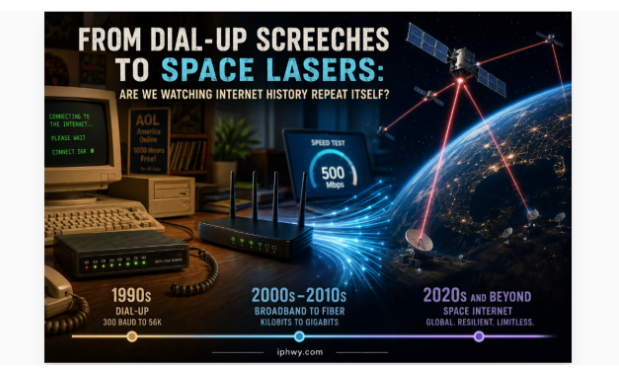
The internet wasn’t always fast, seamless, and always available. It started painfully slow. We had 300 baud modems that moved data at roughly 0.3 kilobits per second.
Then came–>
- 1200 baud
- 2400 baud
- 9600 baud
- 14.4K
- 28.8K
- 33.6K
- 56K
Every jump felt revolutionary and every upgrade felt like the future had arrived. And yet, looking back now, those speeds feel prehistoric. Downloading a photo could take minutes to hours. Downloading software could take hours to days! Streaming video? That would have sounded like science fiction. Then, everything accelerated…
- Dial-up gave way to DSL.
- DSL gave way to cable broadband.
- Cable gave way to fiber.
Suddenly households had access to hundreds of megabits, and eventually gigabit speeds. What took minutes now happens instantly. What once required expensive enterprise infrastructure now happens on smartphones in your pocket. And it all happened incredibly fast.
Why Internet Speeds Exploded So Quickly
The rapid acceleration of terrestrial internet wasn’t accidental. Several forces worked together. Existing telephone infrastructure already reached millions of homes. Cable providers already had physical pathways into neighborhoods.
Then fiber optics changed everything.
Once providers laid fiber, they created infrastructure capable of scaling dramatically for decades simply by improving equipment on both ends. Physics also worked in our favor. Light moves incredibly efficiently through fiber. Latency remains extremely low. Bandwidth capacity is enormous. This is why fiber remains the gold standard today.
Companies like Google Fiber, Verizon through Verizon Fios, and major enterprise carriers continue pushing multi-gigabit speeds because fiber remains incredibly difficult to beat.
Traditional Satellite Internet Was…Honestly Terrible
Let’s be honest.Traditional satellite internet had a terrible reputation.
Providers like HughesNet and Viasat filled an important gap for rural communities, but the experience often came with serious limitations:
- High latency.
- Weather interruptions.
- Data caps.
- Slow speeds.
- Frustrating gaming and video performance.
The problem wasn’t the companies, it was physics. These satellites operated roughly 22,000 miles above Earth in geostationary orbit. That meant signals had to travel enormous distances. Latency often reached 600 milliseconds or more. For modern applications, that simply doesn’t work well.
SpaceX Changed the Conversation
SpaceX fundamentally disrupted satellite internet with Starlink. Instead of using geostationary satellites, Starlink deployed thousands of satellites in low Earth orbit. Since they were much closer to Earth, you also had much lower latency and faster speeds.
Suddenly satellite internet became practical for:
- Remote workers
- Rural communities
- Maritime fleets
- Airlines
- Emergency responders
- Military deployments
- Disaster recovery operations
- Travelers and RV users
- Entire regions lacking terrestrial infrastructure
And then came the truly futuristic part. These satellites increasingly communicate with one another using laser links.
Yes… actual space lasers.
Years ago, that sentence would have felt ridiculous to write. And yet, here we are.
Could Space Internet Eventually Rival Fiber?
This is where things become fascinating. Will satellite internet replace fiber in major cities?
Probably not.
Fiber still dominates in dense metropolitan environments because it offers:
- Lower latency
- Higher capacity
- Greater consistency
- Easier scaling in concentrated areas
But satellite may dominate markets where fiber deployment is expensive, slow, or impossible. Areas such as:
- Rural America.
- Remote islands.
- Developing nations.
- Ships.
- Aircraft.
- Military operations.
- Temporary infrastructure projects.
- Disaster recovery.
And perhaps even more interesting… Satellite networks may eventually outperform certain undersea fiber routes for long-distance communications because light travels faster through vacuum than it does through glass. That creates fascinating possibilities for:
- Global finance
- Defense systems
- International enterprise traffic
- Ultra-low latency trading
- Global cloud infrastructure
That possibility alone should have business leaders paying attention.
The Bigger Business Story Many May Be Missing
This isn’t just a consumer internet story, it’s an infrastructure transformation story. For decades, traditional telecom providers controlled connectivity. But what happens when aerospace companies begin competing for that role? What happens when global internet infrastructure increasingly moves beyond terrestrial carriers? Orwhat happens when connectivity becomes available virtually anywhere on Earth?
Yep… Entire business models could shift.
- Telecom.
- Cloud infrastructure.
- Disaster recovery planning.
- Remote workforce design.
- Military communications.
- Global logistics.
- Even national security.
This story is far bigger than faster Netflix streaming.
One Lifetime of Technological Madness
Think about what many of us have witnessed in a single lifetime. Dial-up internet, broadband, smartphones, cloud computing, streaming media, and artificial intelligence.
And now…
Internet being delivered from space through orbital networks using laser communication! That’s an astonishing amount of technological acceleration for one generation to witness. That old modem handshake sound may feel ancient, but it wasn’t the end of the story. It was only the beginning. And the next great connectivity revolution may already be orbiting above your head.