

I Didn’t Discover the Hacker Community at DEF CON. I Watched It Grow Up.
Coming back to DEF CON in 2026 after many years away has been a little surreal.
I attended several of the early DEF CON conferences… four or five of the first ten, if my memory serves me correctly. Then life, careers, technology, and a few decades happened.
Walking around DEF CON again this week, surrounded by thousands of hackers, security researchers, technologists, vendors, villages, badges, hardware and ideas, I found myself thinking less about what has changed since I was last here and more about just how long this journey has actually been.
Because my story with this community didn’t begin at DEF CON.
It began before DEF CON existed.
Long before the Web, social media, Wi-Fi, cloud computing, or even the term “cybersecurity” as we use it today, I was online under the handle RipperX. As a matter of fact, my ‘ripperx@yahoo’ email is still hanging around (rarely used) today.
Back then, “going online” meant something very different.
It meant a telephone line.
A terminal.
A modem.
And that unmistakable sound of two machines negotiating a connection.
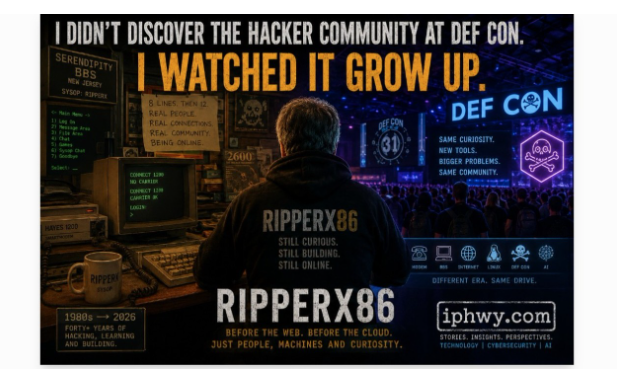
I started in the CompuServe era and eventually began running my own BBS using Wildcat!. That grew into Serendipity, running ‘Major bbs’ … a multi-line bulletin board system operating in New Jersey.
Eventually there were eight lines, then twelve.
And every one of those connections meant an actual telephone line, modem and serial connection waiting for somebody to dial in.
People came to Serendipity to chat, play chess and checkers, exchange messages, share files and download software and graphics.
Serendipity also became popular for another reason… information.
Long before Google, YouTube, Reddit, GitHub, or even the Web, finding obscure technical information often meant knowing the right person, or knowing the right BBS number. My file libraries became known for everything from game cheats, Easter eggs and technical references to underground hacker and phone-phreaking material. I even had a complete scanned copy of The Anarchist Cookbook, which was something of a magnet for curious callers at the time.
People exchanged knowledge about computers, telecommunications, tone boxes, phone systems, hardware tricks and the strange little discoveries we made while experimenting with technology.
Some of it was useful. Some of it was questionable. Some of it was probably ridiculous.
But information that today can be found with a five-second search could be genuinely difficult to obtain then.
And if your BBS had it, people remembered your number.
We didn’t call it social networking.
We just called it being online.
And downloading something required patience.
A 3 MB GIF could become a multi-hour commitment.
You’d start the transfer using XMODEM, Kermit or ZMODEM and hope the connection survived long enough to finish.
A dropped phone line several hours into a download could teach you things about emotional resilience that no leadership seminar ever will.
Then the technology started moving faster.
I watched modem speeds progress from 1200 and 2400 baud through 9600, 14.4K, 28.8K, 33.6K and eventually USRobotics X2 56K.
I experimented with Unix and Linux, ELM, SLIP and PPP.
I used Digi serial hardware and a Shiva LanRover to manage incoming connections. Eventually I had a fractional T1 running into my home.
Looking back, what started as a BBS had gradually become something resembling a tiny ISP.
And none of this was plug-and-play.
Those of us from that generation remember moving jumpers on internal modems and sound cards because IRQs, I/O addresses and DMA channels couldn’t conflict.
We remember CONFIG.SYS and AUTOEXEC.BAT.
HIMEM.SYS. EMM386. Upper memory. High memory.
The eternal battle to squeeze enough conventional memory out of DOS to actually run the program you wanted.
I remember 20 MB hard drives feeling enormous.
I remember individual SIPP RAM chips, SCSI…”scuzzy”…and when IDE and VESA Local Bus felt revolutionary.
By 1993-94, I was running early Slackware Linux and rebuilding kernels to support hardware. On the systems of the time, a kernel build could become an overnight project.
There was no Stack Overflow.
No YouTube walkthrough.
And certainly no AI assistant waiting for you to describe the error.
There were manuals, man pages, other hackers, BBSs, experimentation and persistence.
You broke things.
Then you figured out why.
And somewhere along the way, you actually learned how the machine worked.
We also discovered multiplayer networking before clicking “Join Game” was a thing.
We’d physically network PCs together for DOOM, Wolfenstein 3D, and Rise of the Triad (ROTT).
Sometimes getting all the computers talking to each other took longer than the game.
But when it worked?
It was magic.
Over the following decades, I watched this strange little technical culture slowly move into the mainstream.
I remember watching Leo Laporte during the ZDTV and Call for Help era and seeing technology that once belonged primarily to enthusiasts becoming television.
Later, people like Darren Kitchen and Hak5 brought hacking hardware, security tools and techniques to an entirely new generation through online video. At the time, I was lucky enough to get one of his first Pineapples.

Then YouTube exploded.
Information that once required knowing the right person, finding the right BBS, reading the right manual, or simply spending hours experimenting became available to millions of people almost instantly.
And now I’m back at DEF CON.
The scale is different.
The hardware is different.
The attacks are different.
The stakes are certainly different.
Today we’re talking about cloud infrastructure, zero trust, ransomware, nation-state actors, supply-chain attacks, AI, autonomous agents and security problems that would have sounded like science fiction when I was listening to a modem negotiate a 1200-baud connection.
But walking around DEF CON this week, I realized something.
The technology changed.
The tools changed.
The terminology changed.
But the curiosity never did.
That instinct to take something apart simply because you want to understand how it works is still here.
The willingness to experiment is still here.
The desire to make technology do something its designers may never have imagined is still here.
And the community is still here.
I didn’t discover the hacker community at DEF CON.
I watched it grow up.
And apparently, somewhere along the way, I grew up with it.
My handle back then was RipperX.
After nearly four decades, it seems appropriate to bring it forward a little.
RIPPERX86
Same curiosity.
New era.
And after all these years… still online.