
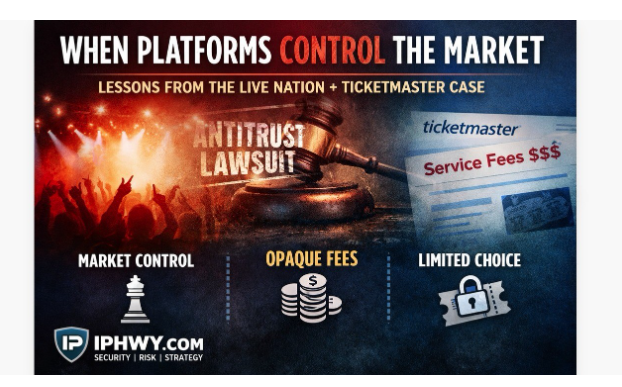

For years, consumers have voiced frustration with the ticket-buying experience. The rising costs, confusing fees, and a lack of meaningful choice. What’s changing now isn’t the behavior, it’s the level of scrutiny. The growing legal and regulatory focus on Live Nation Entertainment and its subsidiary Ticketmaster signals something more significant than a dispute over ticket prices. It highlights a broader issue… what happens when a single entity gains control across an entire ecosystem?
The Real Issue Isn’t Price… It’s Control!
It’s easy to frame this as a pricing problem, but it’s not. At its core, this is about structural control. Through vertical integration, Live Nation operates across multiple layers of the live entertainment industry…
- Artist promotion and management
- Venue ownership and exclusive agreements
- Ticketing distribution via Ticketmaster
Individually, each of these roles is legitimate. Combined, they create a system where market influence becomes market control. And when that happens, traditional market dynamics, competition, transparency, and consumer choice begin to erode.
The Fee Structure as a Symptom, Not the Cause
Consumers often point to fees as the primary frustration. The service charges, processing fees, and venue or facility fees. But these are not the root problem… they’re a visible symptom of a deeper structural design. In systems where competition is limited and access is controlled, pricing becomes less about market forces and more about what the system can sustain. This is a pattern we see repeatedly across industries…
- Complexity obscures accountability
- Pricing lacks transparency
- Consumers absorb the cost
Once Again… The Illusion of Choice
From a consumer perspective, it often appears there are multiple options available. In reality, the system frequently dictates the path. The venue determines the ticketing platform, the promoter determines the venue, and the artist is contractually tied into the ecosystem. What looks like choice is often predefined routing through a controlled system. This is not unique to ticketing, it’s a hallmark of highly consolidated platforms.
Why I Feel This Matters Beyond Entertainment
At first glance, ticketing may not seem like a critical industry. But the structural pattern should feel familiar. In cybersecurity and risk management, we routinely evaluate…
- Concentration risk
- Single points of failure
- Opaque systems with limited oversight
- Control without sufficient accountability
The Live Nation-Ticketmaster model reflects many of these same characteristics, just applied in a different domain. When control is centralized and transparency is limited, the system becomes inherently imbalanced.
A Broader Shift Toward Accountability
The increasing regulatory attention is part of a larger trend. Across industries, I believe we’re seeing renewed focus on…
- Antitrust enforcement
- Platform accountability
- Consumer protection in digitally mediated markets
The key question regulators are now asking is not simply whether prices are high, but whether the structure itself limits fair competition. That distinction matters.
For years, the challenges in ticketing were dismissed as an inconvenience… something consumers simply had to tolerate. What’s happening now suggests a potential shift in perspective. This is no longer just about ticket prices. It’s about how systems are designed, who controls them, and whether that control is exercised fairly. Those are questions that extend far beyond entertainment.
The views expressed here are my own and do not reflect those of my employer.